


Discover how automatic watches harness kinetic motion for precision timekeeping, from rotor mechanics to luxury craftsmanship, in this collector's guide.
Automatic Timepieces Deliver Unmatched Craftsmanship for Discerning Collectors
29 oct 2026

How Automatic Watches Turn Wrist Motion Into Time
Automatic watches are mechanical watches that wind themselves as you move. A weighted rotor inside the case swings with normal wrist motion, winding a mainspring. That spring releases energy in controlled amounts to power the watch - no battery and no daily hand-winding required.
When you take the watch off, it keeps running until its stored energy is used. Many automatic movements offer roughly two days of reserve, though modern designs can run longer. They are less precise than quartz watches, but collectors value the visible engineering, lasting repairability, and connection to traditional watchmaking.
Automatic watchmaking has deep roots. Credible early self-winding designs date to Swiss watchmaker Abraham-Louis Perrelet in the late 1770s, while John Harwood's 1923 invention helped bring self-winding technology to the wrist.
At Elizalde Jewelers, we appreciate lasting craftsmanship in every form, alongside jewelry “crafted from real 10K, 14K, or 18K gold as described, never plated, never filled, and never imitation.” We do not carry 9ct products.
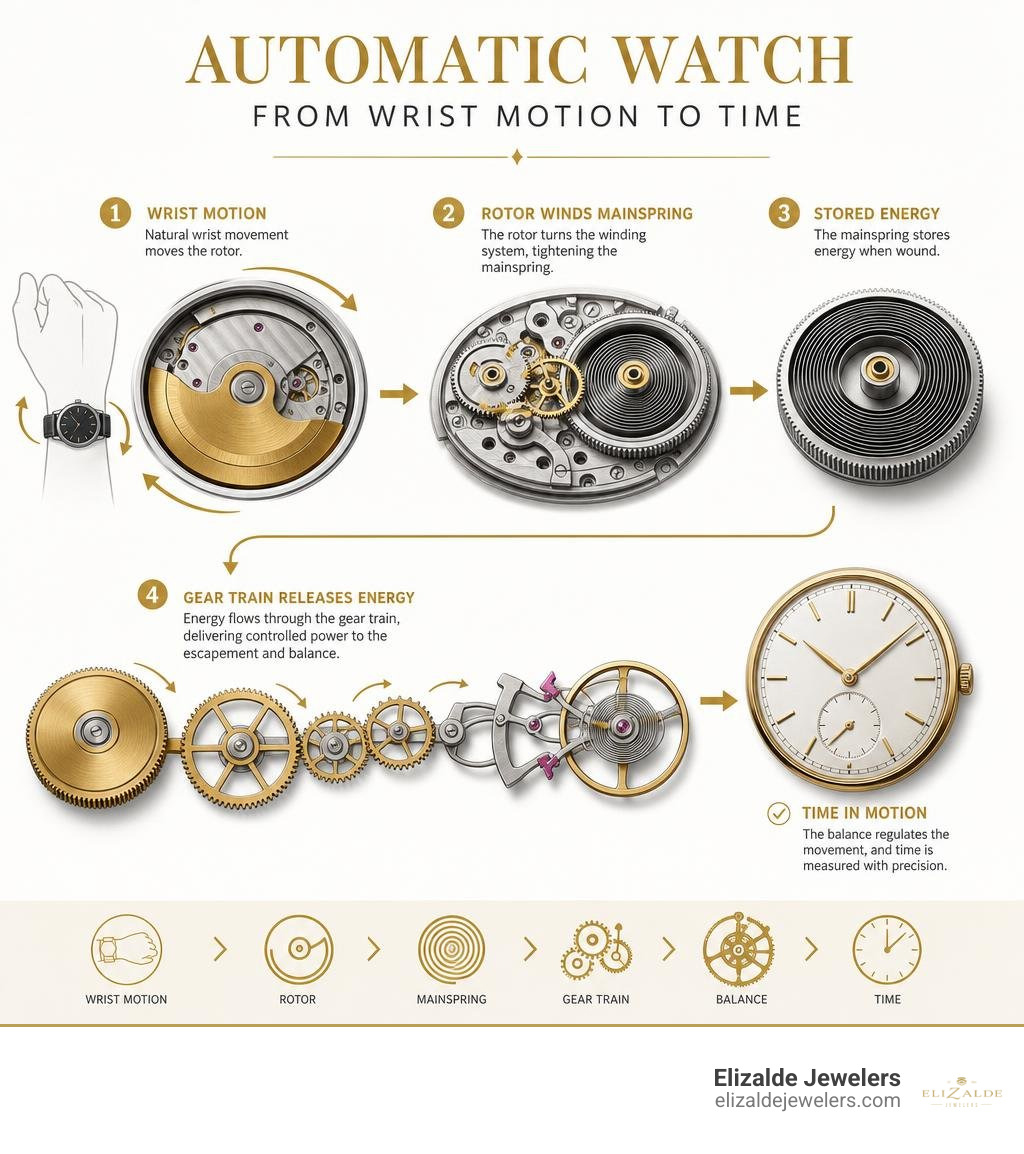
How Automatic Watches Harness Kinetic Energy to Measure Time
To understand why horological enthusiasts are captivated by self-winding timepieces, it helps to examine how mechanical movements contrast with battery-powered alternatives. While quartz watches rely on a tiny battery and an oscillating quartz crystal to pulse a stepper motor, mechanical calibers generate their life entirely from physical engineering.
| Feature | Automatic (Self-Winding) | Manual-Wind Mechanical | Electronic Quartz |
|---|---|---|---|
| Power Source | Kinetic energy via weighted rotor | Manual crown winding | Chemical battery cell |
| Energy Storage | Coiled mainspring barrel | Coiled mainspring barrel | Miniature battery cell |
| Average Power Reserve | 38 to 80 hours | 40 to 72 hours | 2 to 5 years per battery |
| Typical Daily Accuracy | -10 to +30 sec/day (COSC: -4/+6) | -10 to +30 sec/day | ±15 seconds per month |
| Service Interval | 3 to 7 years | 3 to 7 years | Battery swap every 2 to 5 years |
| Longevity & Repairability | Multi-generational heirloom | Multi-generational heirloom | Limited by electronic circuit lifecycle |
An automatic caliber captures the kinetic energy generated by your natural daily movements. When you walk, gesture, or adjust your desk, a center-weighted rotor swings freely on an axle. This motion turns a series of reduction gears that wind the mainspring, creating constant tension and providing autonomous operation without manual effort.
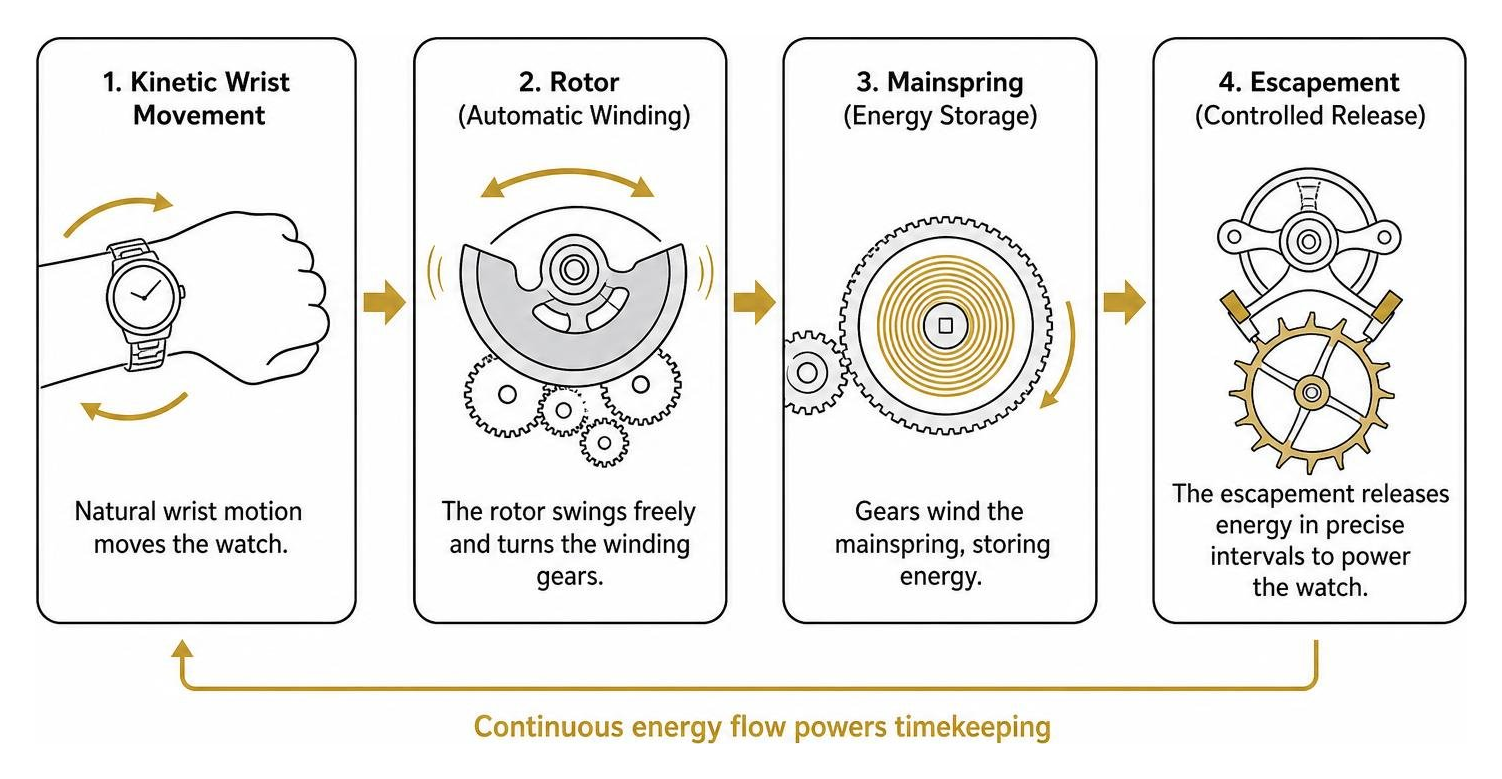
The Anatomy of Motion: Rotors, Mainsprings, and Energy Storage
At the heart of every automatic movement is the weighted rotor—a semicircular oscillating mass mounted on ultra-low-friction ball bearings. When gravity and arm movements rotate this weight, it engages a winding mechanism. Many modern watches feature bidirectional winding systems, which charge the movement regardless of whether the rotor spins clockwise or counterclockwise.
The generated force is channeled into the mainspring barrel, where a tightly coiled ribbon of specialized spring steel stores the potential energy. Even accessible mechanical calibers can maintain steady energy reserves of 40 hours or more from simple daily wear, turning casual movement into consistent timekeeping.
Escapement Regulation and Slipping Spring Protection
Once energy is stored in the mainspring, it must be released evenly. The escapement mechanism controls this process:
- The mainspring turns the gear train, which drives the escape wheel.
- The escape wheel engages the pallet fork, pushing it back and forth.
- The pallet fork delivers regular impulses to the balance wheel, causing it to oscillate at a precise frequency (typically 21,600 to 28,800 vibrations per hour).
- The balance spring (hairspring) regulates each oscillation, ensuring the gear train advances the hands in smooth, micro-stepping increments.
Because an automatic watch winds constantly while on the wrist, it requires protection against overwinding. Early mechanical designs could break if wound past maximum tension. Modern calibers resolve this with a slipping bridle clutch. When the mainspring reaches full tension, the end of the spring slips smoothly along the inner wall of the barrel, preventing strain whether you are wearing classic dress styles or robust daily tool watches.
The Historic Evolution of Self-Winding Engineering

The journey of self-winding mechanisms spans nearly two and a half centuries of continuous innovation. What began as an experimental novelty for eighteenth-century pocket watches has evolved into the pinnacle of wearable personal engineering.
From 18th-Century Pocket Prototypes to Modern Wrist Calibers
The earliest credible record of a functional self-winding movement dates to late 1776 or early 1777, crafted by Swiss watchmaker Abraham-Louis Perrelet. Perrelet’s design utilized a side-weighted swinging arm inside a pocket watch. However, because pocket watches remained stationary inside a waistcoat pocket rather than moving continuously on an active wrist, these early mechanisms often failed to generate sufficient power reserve.
The real breakthrough occurred after World War I as wristwatches gained widespread popularity. In 1923, British watch repairer John Harwood patented the first commercially produced automatic wristwatch caliber. Harwood’s design used a weighted "bumper" rotor that swung back and forth in a 180-degree arc, banking against small spring-loaded bumpers on either side. Approximately 30,000 of these timepieces were manufactured before the economic turmoil of the Great Depression forced the firm’s closure in 1931.
During the 1930s, horological engineering advanced rapidly. Glycine developed modular automatic calibers that allowed companies to produce self-winding movements more efficiently, while other Swiss pioneers introduced a 360-degree centrally mounted rotor that extended autonomous power reserves up to 35 hours. These mid-century breakthroughs established the foundation for the vintage-inspired automatic timepieces celebrated by enthusiasts today.
Modern Innovations in Automatic Watches and Rotor Architecture
In 1948, Eterna revolutionized rotor reliability by introducing miniature steel ball bearings to support the oscillating weight. This innovation significantly reduced friction, lowered wear on the central axle, and became the global construction standard still used in modern horology.
Today, rotor technology continues to advance. High-end manufactures have engineered peripheral geared rings that wind the mainspring from the outer perimeter of the movement, eliminating the central rotor entirely. This architecture permits ultra-thin case profiles while keeping the mechanical artistry fully visible. In addition, silicon hairsprings and antimagnetic alloys now shield high-performance sports divers and chronometers from magnetic fields exceeding 15,000 gauss, ensuring stability in our digital, device-filled environment.
Comparing Movement Tiers Across Mechanical Horology
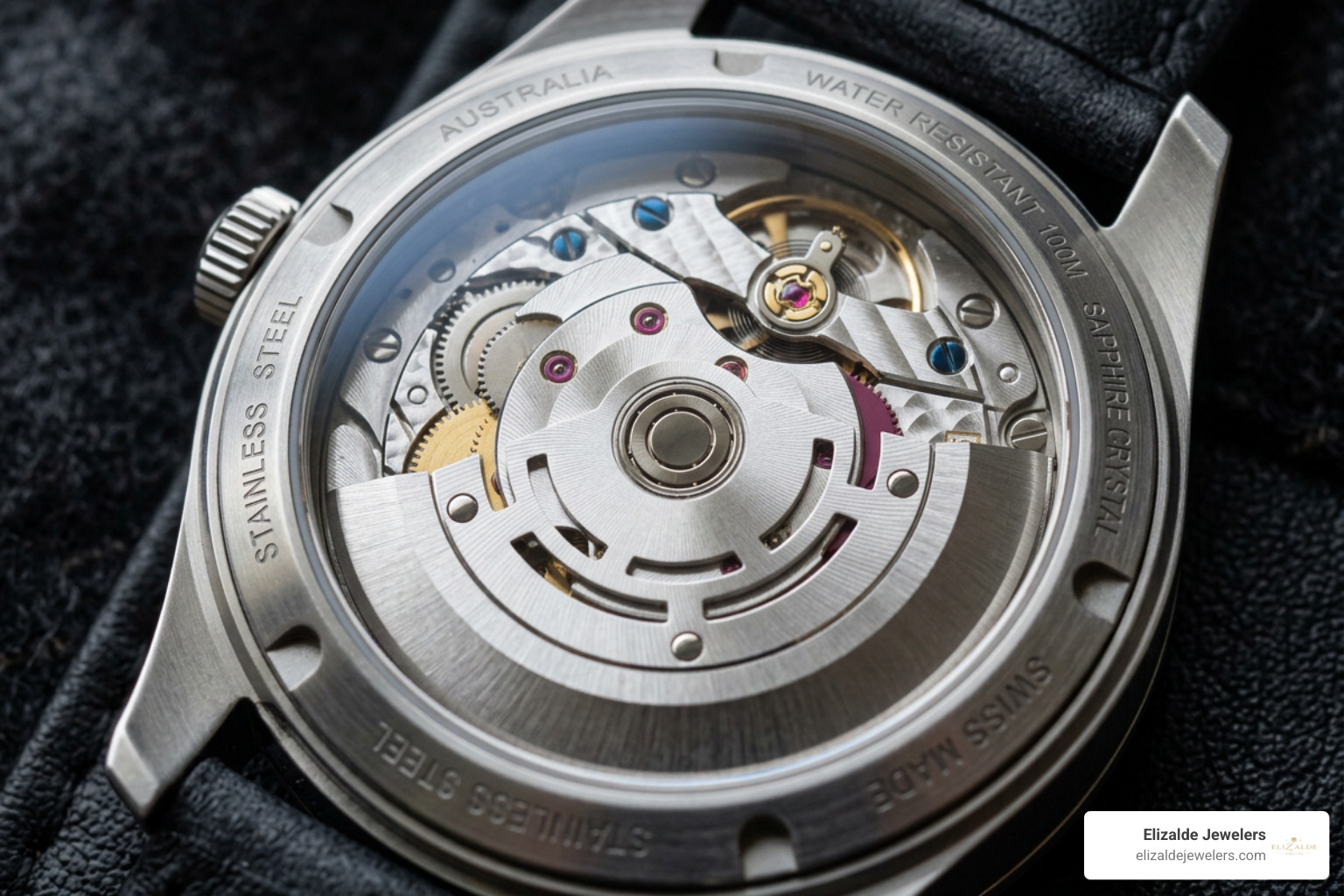
Understanding automatic movements requires looking at how different calibers are constructed, adjusted, and finished. While all automatic movements share the same fundamental operating principles, execution varies significantly across different tiers.
Workhorse Calibers versus Hand-Assembled Luxury Movements
Mechanical movements generally fall into three distinct classifications:
- Standard Workhorse Calibers: Japanese calibers (such as the Seiko 4R36 or Miyota 8000/9000 series) and Swiss movements (like the ETA 2824-2 or Sellita SW200) prioritize structural durability, reliable mass production, and straightforward serviceability. These movements power many refined everyday mechanical watches, delivering years of operation with minimal fuss.
- Modified Production Calibers: Movements such as the Swatch Group’s Powermatic 80 adapt proven architectures with optimized mainspring barrels and adjusted beat rates to achieve extended 80-hour power reserves.
- Hand-Assembled In-House Movements: Manufactured by historic high-horology houses, these calibers undergo individual hand-finishing, beveling (anglage), circular graining (perlage), and Geneva striping (Côtes de Genève). They are tested rigorously in multiple temperature environments and wrist positions to achieve stringent chronometer certifications, such as the Swiss Official Chronometer Testing Institute (COSC) standard of -4/+6 seconds per day or Superlative Chronometer standards of -2/+2 seconds per day.
Key Performance Factors in Modern Automatic Watches
When evaluating automatic calibers, several key performance metrics define their quality and wearability:
- Operating Frequency (Beat Rate): Most calibers operate between 21,600 vibrations per hour (3 Hz, producing 6 ticks per second) and 28,800 vibrations per hour (4 Hz, producing 8 ticks per second). Higher frequencies create a smoother sweeping second hand and recover more quickly from physical shocks, while lower frequencies reduce wear on internal components and conserve power reserve.
- Power Reserve: While the traditional standard has long hovered around 38 to 42 hours, modern engineering has expanded standard autonomy. Using low-friction alloys, calibers featured in advanced lightweight titanium automatics now frequently offer 60 to 80 hours of run time, allowing you to take a watch off on Friday evening and put it on Monday morning without resetting the time.
- Jewel Count: Synthetic ruby bearings (usually numbering between 21 and 35) are set at critical pivot points across the gear train to minimize metal-on-metal friction and preserve lubricating oils.
Essential Care, Maintenance, and Selection Criteria
A quality automatic watch is built to last for generations when properly maintained. Unlike electronic smartwatches or quartz pieces that face planned obsolescence, a mechanical caliber can be disassembled, cleaned, adjusted, and repaired indefinitely.
Durability Factors: Crystal Materials, Water Resistance, and Casework
When choosing a mechanical watch, case materials and external specifications are just as critical as the internal movement:
- Dial Protection: Sapphire crystal is the gold standard for scratch resistance, registering 9 on the Mohs mineral hardness scale (second only to diamond). High-grade mineral crystals like Hardlex offer increased shatter resistance against sharp impacts, while acrylic crystals provide classic vintage warmth.
- Case Construction: Solid 316L stainless steel provides dependable corrosion resistance for daily wear. Premium models and integrated luxury sports watches often incorporate lightweight Super Titanium alloys or scratch-proof ceramic bezels to preserve their finish over decades of use.
-
Water Resistance Ratings:
- 30m to 50m (3 to 5 ATM): Splash resistant; suitable for handwashing and light rain, but not swimming.
- 100m (10 ATM): Suitable for recreational swimming, snorkeling, and daily water exposure.
- 200m+ (20 ATM): Certified sports and diver standard; features screw-down crowns and robust caseback gaskets suited for scuba diving and high-impact water sports.
For those who regularly take on extreme environments or need tactical impact resistance alongside their mechanical collection, pairing a daily automatic with heavy-duty resin timepieces like Casio G-Shock watches gives collectors complete versatility for any activity.
Service Schedules and Power Reserve Management
To keep your mechanical watch running accurately, follow these practical maintenance guidelines:
- Service Intervals: An automatic watch should undergo professional maintenance every 3 to 7 years. Over time, synthetic lubricating oils dry out, and microscopic wear particles can increase friction within the gear train.
- Gasket Checks: Have your watch pressure-tested every 1 to 2 years if you swim or dive regularly, as rubber water-resistance gaskets naturally degrade when exposed to heat, saltwater, and chlorine.
- Manual Priming: If your watch has stopped completely, gently wind the crown 20 to 30 full revolutions before putting it on. While the rotor will wind the watch as you move, priming the mainspring manually ensures the balance wheel receives immediate, consistent amplitude for optimal accuracy.
- Storage and Winders: If you rotate between several watches, a mechanical watch winder can keep calendar and complication movements running smoothly. If stored in a drawer, simply winding the watch once every month or two keeps internal lubricants properly distributed.
Frequently Asked Questions About Mechanical Timepieces
How does an automatic movement differ from a manual-wind watch?
Both styles are mechanical movements powered by a coiled mainspring, but they differ in how that spring is tensioned. A manual-wind watch requires you to turn the winding crown by hand every day or two to maintain power. An automatic watch contains a weighted oscillating rotor that swings with the natural movement of your wrist, winding the mainspring continuously while you wear it.
How long will a self-winding watch run when not worn?
Most standard automatic watches run for 38 to 42 hours once fully wound, which equals roughly two days of autonomous operation off the wrist. Modern calibers with optimized gear trains or extended mainsprings can run for 60 to 80 hours, allowing them to sit unworn over an entire weekend without stopping.
What causes an automatic movement to lose accuracy over time?
Mechanical accuracy can shift due to several real-world factors:
- Positional Variance: Gravity exerts differing effects on the balance wheel depending on whether the watch is resting dial-up, dial-down, or crown-down.
- Temperature Fluctuations: Extreme heat or cold causes delicate metal springs to expand or contract slightly, altering their oscillation rate.
- Magnetic Fields: Placing a watch near laptop speakers, smartphones, or magnetic bag clasps can magnetize the hairspring, causing the coils to stick together and making the watch run fast.
- Lubricant Aging: Over 3 to 7 years, lubricating oils break down, increasing internal friction and slowing the movement.
Conclusion
Automatic watches represent a rare bridge between historic artisan craftsmanship and daily practical utility. Each sweep of the second hand is powered entirely by your own physical motion, connecting you directly to centuries of horological engineering. Whether you are searching for your first mechanical timepiece or adding an iconic design to a growing collection, a well-built automatic watch provides lifetime enjoyment and lasting heirloom value.
At Elizalde Jewelers, our family-owned small business is dedicated to helping you mark life's milestones with authentic quality. Alongside exceptional timepieces, our jewelry collections are “crafted from real 10K, 14K, or 18K gold as described, never plated, never filled, and never imitation.” We invite you to explore curated collections of luxury timepieces and discover the unmatched character of authentic mechanical craftsmanship.
